

Private equity has become an essential component of institutional portfolios, offering access to companies and strategies beyond public markets. Within this asset class, one segment is experiencing rapid growth and attracting significant investor interest: secondaries.
At Nicola Wealth, we view secondaries as an increasingly important opportunity in private markets, both for diversification and for generating attractive risk-adjusted returns.
What Is a Private Equity Secondary?
A secondary transaction occurs when an investor sells their existing interest in a private equity fund to another investor. Unlike primary investments, where capital is committed to new funds at inception, secondaries involve buying into funds or assets that are already partway through their lifecycle.
This structure offers several advantages:
- Visibility into underlying assets: Investors can review the portfolio companies before committing capital, reducing the uncertainty associated with blind-pool investing.
- Shorter duration: Because the fund is already partially invested, the time to liquidity and distributions is typically shorter than in primary commitments.
- Discounted entry points: Buyers often acquire interests at a discount to net asset value (NAV), creating potential for enhanced returns.
One of the most important roles of the secondary market is its function as a liquidity engine for private equity. Just as public equity investors rely on stock exchanges for liquidity, private equity investors increasingly rely on the secondary market to rebalance and optimize their portfolios. This dynamic is particularly relevant today, as slower exits and distributions have created a backlog of unrealized holdings across private equity funds.
Structural Drivers of Growth
The secondaries market has seen rapid growth over the last 10 years, with total transaction volume increasing from $42 billion in 2015 to over $220 billion in 2025.
In addition to the structural advantages secondaries offer investors, several factors underpin the strong growth of the market:
- Demand for liquidity: Private equity is a long-term asset class, but investors still need flexibility. Secondaries provide a mechanism for liquidity without waiting for the fund’s general partner (GP), which manages the investments, to exit all portfolio companies.
- Institutional investors at target allocations: Many large pension funds, endowments, and sovereign wealth funds have reached their target allocations to private equity. With slower exits and distributions in recent years, these investors face a challenge: their portfolios are overweight in private equity relative to other asset classes. To rebalance, they increasingly turn to the secondary market to sell fund interests and manage liquidity.
- Market maturity: As private equity has grown into a multi-trillion-dollar industry, the secondary market has evolved from a niche solution into a critical tool for portfolio management.
Secondaries are now an integral part of the private equity ecosystem, offering solutions for both sellers and buyers.
Rapid Growth of the Secondary Market


Source: Evercore 2025 Secondary Market Highlights (2025-Secondary-Market-Survey_Highlights.pdf)
The Emergence of GP-Led Transactions and Continuation Vehicles
Within the secondaries market, one of the fastest-growing solutions is GP-led transactions, particularly Continuation Vehicles (CVs). These structures have become increasingly popular among leading private equity firms and sophisticated investors.
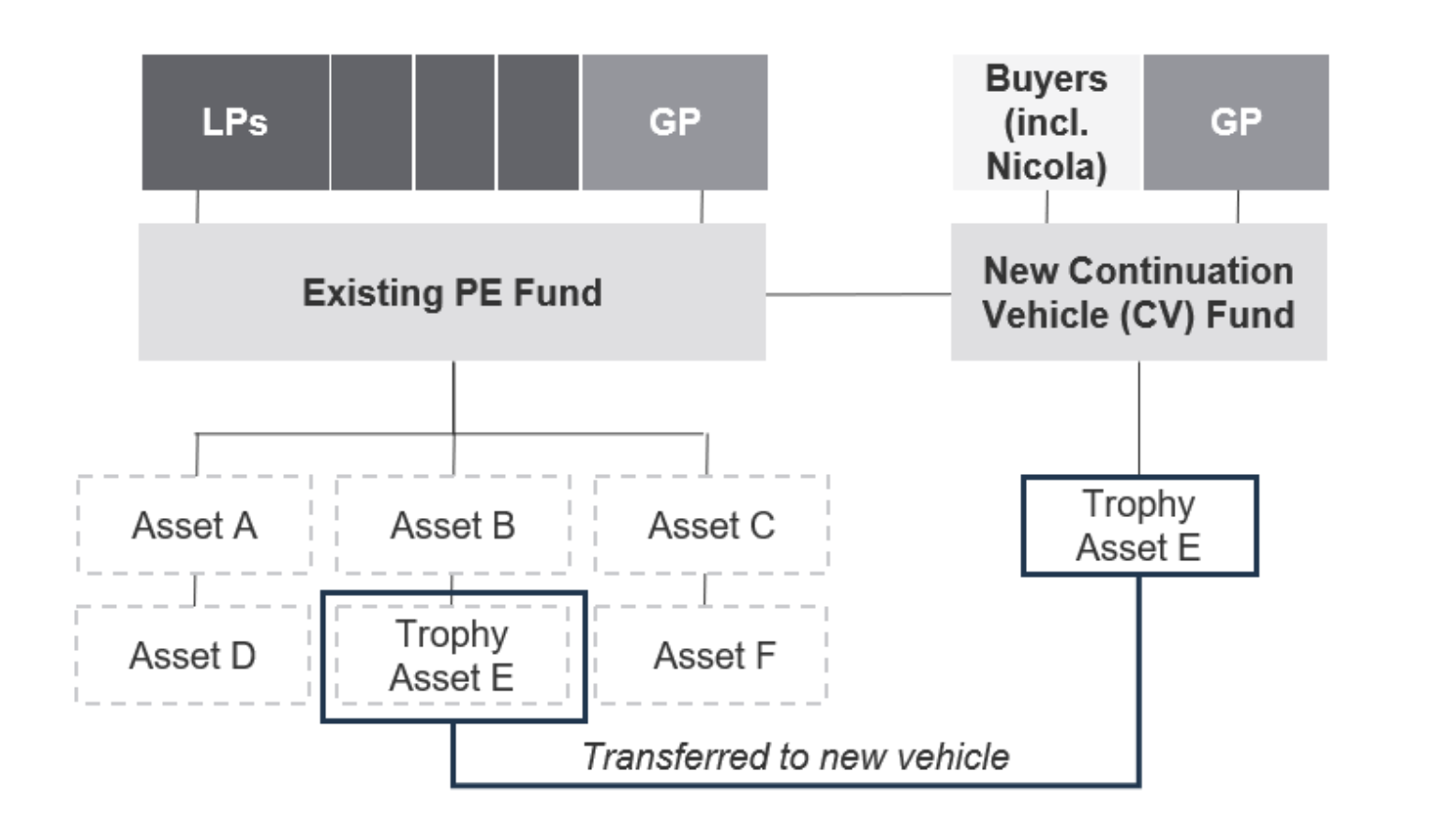
- GP-led secondary: Instead of a traditional limited partnership (LP) investor selling to another LP, the fund’s GP initiates the process. One or more portfolio companies are transferred into a new vehicle, giving existing investors the option to cash out.
- Continuation Vehicle: A type of GP-led transaction where a new fund is created to hold a high-performing company that the GP believes has further upside but requires additional time to realize its full potential.
The appeal of GP-led secondaries and CVs lies in several key characteristics:
- Access to winners: CVs often include the best-performing assets from a fund, offering concentrated exposure to high-quality businesses.
- Seasoned assets: These companies are already proven performers, reducing underwriting risk.
- Targeted Exposure: Similar to direct co-investments, CVs provide flexibility to select specific portfolio companies, partners, sectors, geographies, and investment vintages for optimized portfolio construction.
- J-Curve Mitigation: Reduced impact of the early negative return period common in private equity, driven in part by lower fee loads compared to primary fund commitments, where fees are typically highest in the early years.
For sophisticated investors, GP-led secondaries and CVs combine many of the benefits of private equity ownership with greater visibility and a more controlled risk profile compared to traditional PE investing.
Illustrative Continuation Vehicle Transaction

Nicola Wealth’s Approach to Secondaries
Nicola Wealth believes in the long-term growth of the secondaries market and the expanding opportunity set it offers. Our strategy reflects this conviction in two ways.
Diversified Exposure with Nicola Private Equity Limited Partnership (PELP)
For high-net-worth clients, Nicola Private Equity Limited Partnership (PELP) provides a fully diversified portfolio across private equity funds, direct co-investments, and secondaries. This approach ensures broad access to private equity as an asset class while mitigating risk through diversification. Investors gain institutional-grade access to the private equity market through a single investment in an evergreen fund structure, which allows for ongoing capital deployment rather than fixed investment periods.
Secondaries represent 15-20% of PELP as of December 31, 2025, and play an important role in this mix, offering shorter duration and enhanced visibility within a balanced portfolio.
Specialized Focus Through Nicola Morningside Vintage Secondaries (MVS)
For certain private wealth and institutional investors seeking targeted exposure, Nicola Morningside Vintage Secondaries (MVS) focuses exclusively on GP-led Continuation Vehicles. This strategy is designed to capture the advantages of seasoned, high-quality assets with strong growth potential, alongside best-in-class private equity partners.
Each MVS fund vintage, or investment period, is expected to invest in 10 to 12 opportunities through a closed-end fund structure, with a goal of fully deploying committed capital within a 12- to 18-month timeframe.
By concentrating on this segment, we provide existing PELP investors with the option to double down on this area of the market and access opportunities typically reserved for large institutional investors.
Nicola Wealth's Strategy for Investing in GP-Led Secondaries


Learn More About Nicola Wealth's Private Equity Strategies
Disclaimer
This material contains the current opinions of the author, and such opinions are subject to change without notice. This material is distributed for informational purposes only and is not intended to provide legal, accounting, tax or specific investment advice. Forecasts, estimates, and certain information contained herein are based upon proprietary research and should not be considered as investment advice or a recommendation of any particular security, strategy, or investment product. This investment is intended for tax residents of Canada who are accredited investors. Residency restrictions apply. Please read the relevant documentation for additional details and important disclosure information, including terms of redemption and limited liquidity. All investments contain risk and may gain or lose value. Please speak to your Nicola Wealth advisor for advice based on your unique circumstances. Nicola Wealth Management Ltd. (Nicola Wealth) is registered as a Portfolio Manager, Exempt Market Dealer and Investment Fund Manager with the required securities commissions.


