

Artificial intelligence (AI) is transforming technology at an unprecedented pace. From AI-powered search tools to smarter health care and self-driving cars, innovations are unfolding rapidly. Behind these breakthroughs lies a critical foundation of physical infrastructure assets. Every AI query is processed in data centres, producing massive computing workloads that require enormous amounts of reliable power and high-speed fibre networks to reach users. Together, these three pillars: data centres, power, and fibre, form the hidden backbone of AI.
Data Centres: The Core of AI
Data centres provide the physical infrastructure that enables AI. This includes the buildings, backup power, cooling systems, and network connectivity needed to run large-scale computing.
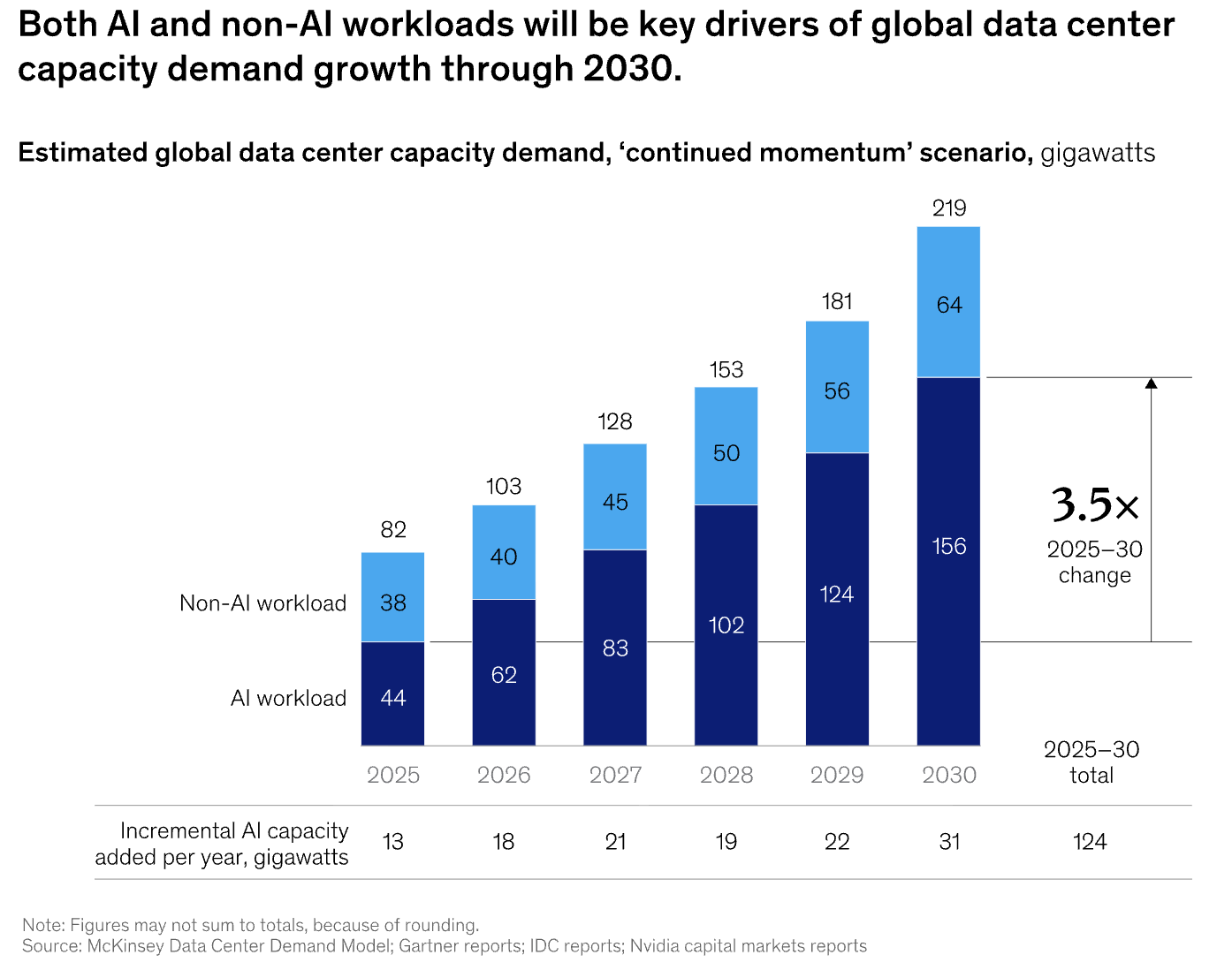
Developing new data centre capacity requires substantial capital investment and long lead times on power connectivity. Global investment in data centres is projected to reach $6.7 trillion by 2030, as AI computing needs more than triple in the next five years¹. Amazon, Alphabet, and Microsoft are leading the charge, collectively committing hundreds of billions in capital expenditures to expand their capacity²,³,⁴. Not only are hyperscalers building their own data centres, but they are also increasingly securing capacity from specialist businesses through multi-decade contracts, some lasting more than 15 years. These agreements provide the data centre owners with stable, predictable revenue from investment-grade counterparties. Customer relationships are also regarded as highly “sticky” as switching providers involves significant costs and technical complexity. With long-term contracted cash flows and a sticky customer base, data centres are emerging as a critical piece of infrastructure investment enabling the AI economy.
Estimated Global Data Centre Capacity Demand

Powering the AI Revolution
An important nuance to note from the chart for data centre demand is that data centre capacity is not measured in bytes, but in watts, i.e. how much power is available for computing. Reliable power is essential to keep data centres running, making energy infrastructure a critical enabler of AI.
Data centres currently consume 3-4% of U.S. electricity, a figure projected to rise to 11-12% by 2030⁶. Over this period, electricity demand for data centres is expected to increase by almost 400 terawatt-hours⁶, growing at a 23% compound annual growth rate. This increase is equivalent to ~2.5 times the power used by all Canadian homes each year⁷.
U.S. Data Centre Energy Consumption


In many U.S. markets, the existing power grid cannot keep pace with demand, creating a natural barrier to entry and driving the need for faster, more resilient solutions. In major hubs such as Northern Virginia, connecting a new data centre to the grid can take more than three years due to capacity limitations and regulatory hurdles. This opens opportunities for established power operators with existing grid access to capture value from growing AI-driven demand.
One example is the partnership between KKR, a leading global investment firm, and Energy Capital Partners (ECP), one of the largest private owners of power generation and renewables in the U.S. In October 2024, KKR and ECP announced a $50-billion initiative to address the energy bottleneck in U.S. data centres⁵. Their first joint project is a $4-billion hyperscale data centre campus in Texas. The facility is strategically co-located with a natural gas power plant operated by Calpine (an ECP portfolio company at the time of the project) to secure a dedicated and reliable energy supply through a long-term power purchase agreement. This project is part of a broader effort to support AI infrastructure growth across the U.S.
Connectivity as the Enabler
The final but equally important pillar of AI infrastructure is fibre, which is needed to connect the data centres to the users of AI. Fibre acts like a modern utility, providing the connectivity that underpins nearly all digital services. Building and maintaining these networks requires significant capital to reach sufficient economic scale. Once in place, fibre has long operational lifespans and in specific markets has resilient economics supported by long-term take-or-pay agreements underpinned by growing demand for high-capacity connectivity.
Hyperscalers are expanding long-haul fibre networks to improve redundancy, reduce outages, and scale capacity for AI workloads. Globally, the build-out of fibre networks could represent a $30- to $50-billion market opportunity⁸. Rising demand for connectivity is expected to drive continued investment in fibre networks, reinforcing its role as an essential foundation for AI.
Investing in AI through Infrastructure
While AI continues to advance at an extraordinary pace, its progress is dependent on the physical assets that support it. Data centres, energy infrastructure, and high-speed connectivity are critical enablers of AI’s scalability and reliability. For investors, these essential building blocks provide a way to participate in the AI revolution while offering the potential for stability that infrastructure investments have historically demonstrated, and without requiring to take a bet on which use cases of AI will be successful.
Nicola Global Infrastructure Limited Partnership
The Nicola Global Infrastructure Limited Partnership (NGI) seeks to provide investors access to a globally diversified portfolio of infrastructure assets. The portfolio is strategically allocated across sectors that we believe are well-positioned to benefit from AI growth, with a 27% allocation to digital assets including data centres and fibre networks, and 13% in power and renewables. NGI currently offers a 4% a year distribution yield that is paid monthly and has a net return target of 7-9%.
1
- 1
McKinsey & Company - The cost of compute: A $7 trillion race to scale data centres (April 2025)
- 2
CNBC – Amazon plans to spend $100 billion this year to capture once in a lifetime opportunity in AI (February 2025)
- 3
CNBC – Google’s $85 billion capital spend spurred by cloud, AI demand (July 2025)
- 4
Microsoft – The golden opportunity for American AI (January 2025)
- 5
Energy Capital Partners – KKR and ECP Announce $50B Strategic Partnership (October 2024)
- 6
McKinsey & Company – How data centres and the energy sector can sate AI’s hunger for power (September 2024)
- 7
Statistics Canada - Based on the annual electricity usage of Canadian households of 165TWh p.a.
- 8
McKinsey & Company – A new growth avenue for telco operators (February 2025)
Disclaimer
This material contains the current opinions of the author and such opinions are subject to change without notice. This material is distributed for informational purposes only. Forecasts, estimates, and certain information contained herein are based upon proprietary research and should not be considered as investment advice or a recommendation of any particular security, strategy or investment product. Information presented here has been obtained from sources believed to be reliable, but not guaranteed. All investments contain risk and may lose value. Please speak to your Nicola Wealth advisor for advice based on your unique circumstances. This is not a sales solicitation. This investment is intended for tax residents of Canada who are accredited investors. Please read the relevant documentation for additional details and important disclosure information, including terms of redemption and limited liquidity. This summary contains targeted returns; actual returns may vary. Distribution yield reflects the annualised fixed distribution rate that NGI is expected to pay to unitholders, based on the NGI’s most recent declared distribution. Distributions are not guaranteed and may vary in amount and frequency over time Nicola Wealth Management Ltd. (Nicola Wealth) is registered as a Portfolio Manager, Exempt Market Dealer and Investment Fund Manager with the required securities commissions.


