
Toronto Office Art
Nicola Wealth has thoughtfully curated our art collection to support artists and charities, aligning with our core value of caring about the well-being of our communities. We proudly display this artwork selection for you to enjoy while you visit our offices.


Island of Light
My work focuses on the changeable relationship we have with nature. Oceans and forests are idealized, radiating an inner light that burns. This heightened effect corresponds to our own yearning for more, wanting to be at one with nature, to control it, to be moved by it, to tame it. As a waterman and the son of a sailor, I’ve spent a lot of time on the waters of the west coast. I know these waters, and yet I can never really know them. The ocean is an endless variety of movement, light and feeling. We can see ourselves in its vastness and depths, its calm and its torrents. Water reflects back to us our inner worlds and emotions.
In my latest depictions of the sea, I have re-cast the ocean as subject and zoomed in on one small section of turbulent water, using contemporary techniques to distill ocean crashes into gesture and form so that we can feel the full impact and chaos of the untamed sea. I use a golden glow to represent the human spirit, depicting it as an extension of nature itself, inseparable from the beautiful chaos of these waves. The vastness of the water reflects the vastness of ourselves - these pieces are both inner and outer landscape. I'm a Canadian artist with work featured internationally in galleries, art fairs, magazines, tv programs and many private collections. I am based in Toronto, Canada and work with a great team of galleries across Canada and US that exhibit and sell my work to clients around the world.


Preacher’s Car
Purchased in support of Vancouver Arts Umbrella Splash Auction, benefiting young people across Metro Vancouver in the visual and performing arts.
By Kevin Boyle
Kevin Boyle is a photographer and artist, living and working in Vancouver, BC. His photographs are meant to challenge the viewers perception by capturing impossible images, whether using long exposures on abandoned buildings, montages, or helicopters and planes. In his Range, DaySleeper and HERD series, he examines the idea of what society has deemed worthwhile and worthless, while breathing new life into what would normally be considered ugly or banal. In his Elemental works, he changes his and the viewers perspective by freeing himself from the confines of gravity, presenting pictures that would otherwise never be seen.
Boyle is a first prize winner in the International Photography Awards and the Fine Art Photography Awards.


$2 bill (AUT6776980)
By Peter Andrew
Peter Andrew is an award-winning photographer from Toronto, Canada. Self-taught and armed with an apprenticeship at West Side Studio under Chris Gordaneer, Peter quickly developed a shooting style and mantra of 'getting the shot no matter what'. This attitude has taken him to great heights - personally, professionally and quite literally. He is just as comfortable in his studio as he is shooting out the side of a helicopter. His body of work includes advertising, location, portrait and landscape photography.
Since its inception, his "Interchanges" project has taken the artist all over the world in search of a very particular subject: the architectural necessity of city sprawl that takes shape in the web-like intersections of the highway interchange. Andrew’s aerial views and uncanny angles transform otherwise functional, banal constructions into photographic spaces for aesthetic meditation: long, linear shadows present a doubling of sensual, concrete curvatures; the static symmetry of the structure poetically contrasts its witness to perpetual movement; conspicuous green space is carved out in perfect geometry, so that the organic and the inanimate mathematically coexist. For Andrew, these images reveal with new perspective a ubiquitous presence that nonetheless remains largely invisible. His vision of capturing the satisfying beauty of highways infuses the familiar with something new; it is the everyday at a remove, one that allows a privileged glimpse of the veins and arteries of both cities and the sinews that connect them.
His recent “Collectible” series is a macro level exploration of coins, bills and stamps. These images are created with the intention of being reproduced on a very large scale giving the viewer the opportunity to gaze at these tiny artifacts from an unfamiliar perspective. The images point to our sense of nostalgia and our desire to organize and worship the things that we covet.


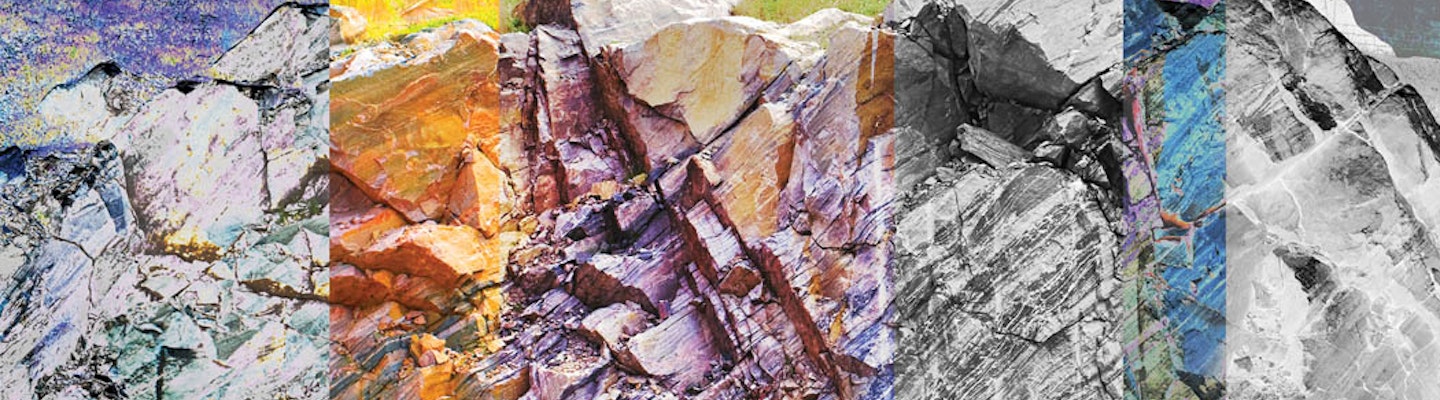
400 North - Rocks
Eugene and Olympia Nicolcev have worked together on prestigious art projects across Europe and North America for over 30 years.
Eugene juxtaposes the Canadian natural and artificial environments to portray a conflict between organic landscapes and sterile, perfected human creations. Building on the foundation of his classical education and using his extensive knowledge of leading-edge technology, Eugene creates works in a post-modern style that fuse the accuracy of photography with the expressionism of painting. The goal of his art is to “free people from their preconceived notions about art”. He explains that he doesn’t want to paint like the artists who have come before because in his words, “it has already been done.”
Olympia, who labels herself “unconventional”, takes her inspiration from the way the laws of science apply to every aspect of nature, from the geometry of flowers to the startling contrast of colours in the natural world. Unlike Eugene’s digital approach she creates a more organic, textural art by incorporating natural elements such as reeds, paper, rocks and sand. During her travels she picks up objects that can be incorporated into her next project. But Olympia also likes to break her own rules as she did during her “cubist period” in which she painted thousands of cubes to float on clear plexiglass or glue on aluminum to create the skyline of a big city. She has said about her life as an artist, “Art is my structure and I’ve never been separated from it, whatever form it takes.”


And then I did cry
By Kezliegh
Kezliegh, also known as Amy Merritt is a Canadian new media artist who grew up in Muskoka, a small region north of Toronto, Ontario. She specializes in contemporary art, often exploring themes of time and place and self-expression. Kezliegh's work features bright colours, digitally painted or drawn strokes, and abstract shapes. Her art is heavily influenced by her background in design and her interest in nostalgia.
Her work has been featured in several publications and has been shown in galleries internationally. Kezliegh's art is a reflection of their own identity and a way of communicating their perspective and experiences with the world.
Kezliegh is currently working hard at becoming a noteworthy artist and producing new work in her small studio in Toronto, Ontario.


Inukshuk
By Cat Marchese
I’m an award-winning photographer who’s always been fascinated by decaying things: crumbling buildings, forsaken institutions, derelict hotels, abandoned subway stations, deserted cities. The structural remains of these once elaborate and peopled places – their ghostly bones – are as intriguing to me as their shed historical skin.
Citybonez™️ pays photographic homage to Toronto's stately skeleton, the city's building blocks manufactured by local brickyards dating back to 1889. The images preserve relics from John Price Brick Maker on Greenwood Avenue, the Milton Pressed Brick Company in Milton, and the Don Valley Brick Works, which produced bricks in ten shades of red, seven shades of buff, olive gold, brown obsidian and mottled for such venerable landmarks as Massey Hall, Casa Loma, the Ontario Legislature and the University of Toronto's Hart House and Convocation Hall. I discovered my reverence for bricks many years ago and became fascinated by their history and the stories each one tells. Digging through cast-offs from Toronto's subway system, skyscrapers, schools, churches, art galleries, libraries and theatres I exhume the mud bones of our city.
In times of uncertainty, I have found solace from the present by unearthing the past. The bricks I photograph offer a fascinating glimpse into the wardrobe of our collective architecture. But more than this, these bricks – these beautiful bones of our evolving city – provide comfort. There is consolation in the planned impermanence of our built environment; in the predictable and continuous cycle of human destruction and creation.


Estuary
By Bryce Barry
Bryce is a fine art photographer and artist based in Vancouver, B.C. Bryce has been exhibiting her work for the past 5 years in galleries, solo exhibitions, private functions, interior design shows and projects. Her work was prominently featured in London, England for a Sky TV series in the main character’s home and the opening credits. Her work has also been featured in print: magazine covers, feature stories and newspapers.
Her photography is evocative, with natural muted tones. A touch of wonder is the dominant theme in her work. She seeks to raise the viewer's curiosity of the natural world. Her works are limited edition archival prints mounted and sealed to wood. The natural raw feel of wood matches the world her works represent. The finished piece reveals a painting like depth and texture drawing the viewer into the scene from any angle.


Gull Grid
Purchased in support of the Art With Heart auction, raising funds to support compassionate, judgement-free care for people living with and at risk of HIV at Casey House.
By April Hickox
April Hickox is a Canadian lens-based artist, teacher and independent curator who lives on the Toronto Islands. Over the course of 37 years, April has mined the distinctions between personal and public sites through film, video, photography and installation. Her work with objects and the still life is rooted in narrative histories that individuals accumulate throughout their lives and the ability of inanimate objects to shape memory. Currently, this direction in her work continues in both photographic and video works with Provenance Unknown and Observation, a series of photographs and video works that explore the studio still life.
April is also known-as a landscape photographer who explores notions of the wild and what we know wilderness to be. Over the years she has continued to document over-lapping layers of human and natural histories, to demonstrate how, with our help, nature is reinvented. She has produced numerous landscape series in Carolinian forest areas including Hancock Woodlands, Point Pelee and the Toronto Island where she has been engaged with an extensive series or work titled Invasive Species. An active community leader, she is the Founding Director of Gallery 44 Centre for Contemporary Photography, and a founding member of Tenth Muse Studio, and Artscape Toronto. For the past seven years she has been a member of the curatorial board of Art With Heart, Casey House. Currently April is an Associate Professor of Photography at the Ontario College of Art and Design University in Toronto.


The Bridge
By Tom Brooks
Tom Brooks is a Canadian communications educator, network instructor, industrial designer and visual artist. He is influenced by non-narrative abstraction, pop art, graphic design and scientific phenomenon. He is currently interested in human evolution and its link to the internet of everything. His current work explores education and man's relationship with work and self-fulfillment in this time of social change. His layered portraits of famous and local artists are influenced by analog recordings of distortion and interference patterns. In some cases these patterns will be layered with images and text.
“I create multimedia works that speak to our changing relationships with work in a media driven society. Political forces and automation are at odds with our traditional notions of work. I feel we must find new purpose in lifelong learning and the ongoing, voluntary, and self-motivated pursuit of knowledge. The Ottawa School of Art is a place where I re-discovered that joy of learning. Learning fosters social inclusion, active citizenship, and personal development. Ongoing learning promotes adaptability, self-sustainability, competitiveness, as well as employability. In my art I use well known images and text to suggest the manipulation of data and the passage of time. I apply acrylic paint using trowels, brushes, rollers, and stenciling. I have displayed my art in many juried, national and local art shows, in Canada. I have a Bachelor of Industrial Design degree, as well as a Bachelor of Education degree."


Steady Mound Removed from Cascading River
Robert Wiseman (b. Montreal) graduated from Concordia University in 1997 with a B.F.A. in Painting & Drawing. He has continued to refine his art practice with an emphasis on painting in oils and drawing with inks and watercolours.
Gripped by the historical lineage of landscape, still-life and figurative painting, Robert Wiseman’s work addresses the tradition of creating meaning through images, made by applying coloured materials to flat surfaces, a practice that dates back 40,000 years. His colour palette and brush strokes are vigilantly measured in a counter-intuitive manner, a strategy for Wiseman to create paintings that are vibrant, whimsical and personal.
In his recent landscape paintings, the figures, flora and architectural forms are rendered with economy and conviction, giving a sense of mass and structure in relation to the air and water, with the elements of the paintings organized quixotically for the viewer to accept and enjoy.
Robert Wiseman brings painting into the realm of the narrative, with mythological underpinnings, yet his primary focus remains the act of painting—the push and pull of colour— the composition and the material. Painters who have influenced him include Goodridge Roberts, Paterson Ewan, John Fox, Richard Diebenkorn and Philip Guston.
Wiseman currently lives and works in the Plateau-Mont-Royal borough of Montreal