

It would be a fair question to ask: What does a 40-year-old movie and its subsequent franchise have to do with one of the most iconic westerns of all time, which, in turn, was a remake of a great Japanese classic?
It may take me a few paragraphs, but eventually, I'll get there.
This is a cautionary tale about a U.S. market dominated by seven mega-cap technology stocks. Any one of which might have been started by some of the characters from "Revenge of the Nerds." Wall Street has dubbed these companies the "Magnificent Seven," perhaps forgetting that, in the end of that movie, Yul Brynner, Steve McQueen, and Horst Buchholz (a German playing a young Mexican gunfighter) were the only ones who survived and each ended up with one $20 gold coin for their troubles.
When we transpose these movies to the S&P 500 today, we can see connections. The Magnificent Seven companies are Apple, Tesla, Microsoft, Nvidia, Google (Alphabet), Amazon, and Facebook (Meta). Their prices have risen sharply in the last twelve months, impacted by A.I., and its promises. "The nerd's revenge" seems like an apt description. As the image below shows, as of August 2023, they comprise 28% of the market cap of the S&P 500, they account for 95% of the market return for the S&P 500, and they represent only 1.2% of the companies within the S&P 500.
The S&P 500 did very well during most of COVID, and by the end of 2021, it was at a record level of 4766.
However, this boom in the prices of these seven companies had little effect on overall equity prices but did elevate their share prices to what one could reasonably say were stratospheric, as noted recently by The Washington Post.


"The Magnificent 7 have rarely been cheap, but this year’s rally has pushed them to rarefied levels. They boast an average P/E ratio of 43, almost double the average ratio of 25 for the rest of the field." - The Washington Post
It would be hard to describe this as a bubble, even with elevated tech stocks and the S&P 500 almost 10% lower today than at the end of 2021. However, it appears that the S&P 500 may be more vulnerable to downward adjustments than other equity markets might be. While it is down from its 2023 peak, reached at the end of July, by more than 5%, it is still up almost 15% year-to-date as of August 18th, 2023.
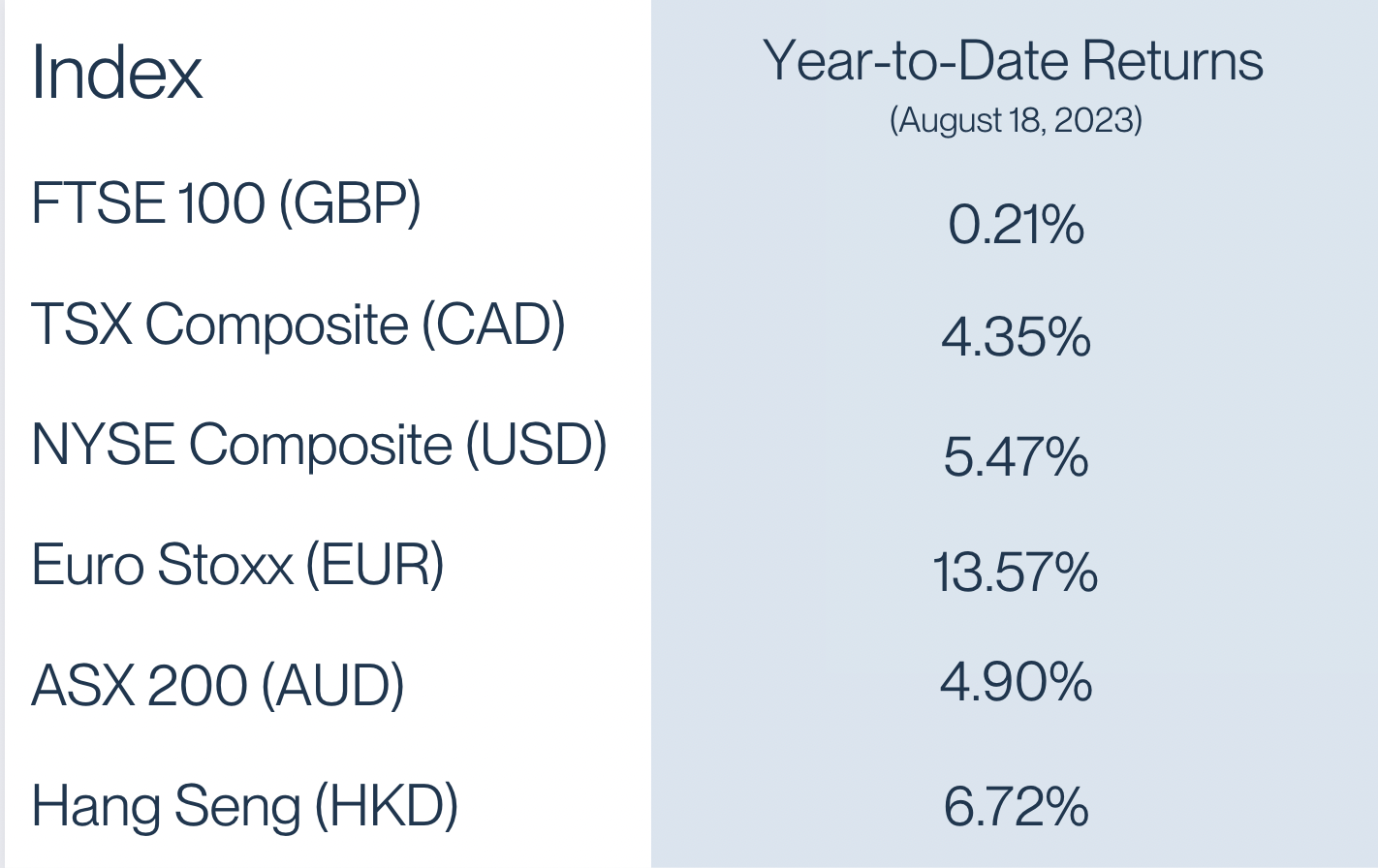
Year-to-date performances in other major markets look like this:

Since Nicola Wealth opened its doors in 1994, we have endorsed a value-based approach with a wide diversification of assets, including real estate, private equity, private debt, bonds, and stocks.
Most of you who will be reading this know that this approach has been used for many decades by a small group of advisors and is sometimes referred to as the Talmudic Asset Allocation Model. The reason for this, as shown by the pie chart below, is that in the Talmud, a man is teaching his son how his wealth should be allocated and managed.


One-third in real estate, one-third in business (private and public equity today), and one-third in reserves (gold in biblical times but fixed income today). This allocation should be adjusted once or twice a year to remain in balance.
Our website features a chart, shown below, that illustrates how this approach has outperformed a traditional balanced portfolio over the long term. For instance, the Nicola Core Composite has provided 60% higher net annual returns between January 2000 to July 2023 with 30% less volatility relative to the Morningstar Canadian Neutral Balanced. See the table below:


However, in 2023 we have fallen behind. Let’s have a look at the numbers.
On August 11th, 2023, a 60/40 blended benchmark* returned 6.08% YTD while several balanced funds** averaged 5.17%. The Nicola Core Portfolio Fund returned 3.68% YTD.
Does this mean we have lost our way or our competitive advantage? Seven or eight months do not make a trend, but they can be long enough to determine if external factors may be distorting some equity returns. Is A.I. having an impact on the price of certain tech companies that should benefit from its use and rise? Will it live up to its hype and make many accountants, lawyers, scriptwriters, actors, and wealth managers redundant?
I think we can safely say that the hype has far exceeded bottom-line profitable applications for A.I. In time, that could well change, but does it justify major companies trading at 43x earnings?
Our Nicola Core Model is not directly comparable to specific equity markets anyway. It is a balanced value-based model with less than one-third of its assets in public equity markets and two-thirds in fixed income and hard assets such as real estate. This approach has realized the following net returns for our clients over the last decade, culminating in the Nicola Core Composite returning 6.58% in 2022 (net of all fees). This was the year when traditional balanced portfolios lost money in both stocks and bonds and were down on average by nearly 10%.


If we looked at returns for the two years leading up to July 2023, we get a much different picture, and our Nicola Core Composite performance not only has superior returns but with much lower volatility (standard deviation) and significantly lower maximum drawdown.


The model we follow is quite similar to some of Canada’s largest pension funds, such as the Canadian Pension Plan (CPP) and Ontario Teachers’ Pension Plan Board, among others. According to The Economist, these funds are considered some of the best investment platforms in the world and have been for well over a decade, starting with a front-page article from the Economist:


The table below shows recent, mid-term and longer-term net results for six different Canadian pensions and the Nicola Core Composite net of fees. You’ll notice a few things.
First, our results in the first six months of 2023 were better than those of most of them and, over the long run, very competitive with world-class pensions with hundreds of billions of dollars to scale costs and expertise.


These pension funds, Canada's "Maple Leaf Revolutionaries," if you will, have done a great job over many decades building wealth for millions of Canadians. We have every right to be proud of their work when compared to their global colleagues.
Our objective for our clients has been to provide access to the breadth of assets that these world-class investors have, enabling our clients to build and preserve wealth safely and effectively.
We are very confident that our model will withstand the test of time.
*The 60/40 blended benchmark is made up the following constituents: iShares Core Canadian Universe Bond ETF (Weight 25%), iShares Core S&P 500 ETF (15%), iShares Core S&P/TSX Capped Composite ETF (35%), iShares Global Government Bond ETF (15%), iShares MSCI ACWI ETF (10%). Returns are gross of management fees and are calculated by Morningstar.
**BMO Asset Allocation Fund, RBC Balanced Fund, TD Balanced Index, Fidelity Canadian Balanced Class Fund, Scotia Canadian Balanced Class Fund, Mackenzie Strategic Income Fund, Franklin Bissett Canadian Balanced Fund, Invesco Canadian Premier Balanced Fund.
Past performance is not indicative of future results. All investments contain risk and may gain or lose value. Please speak to your Nicola Wealth advisor for advice based on your unique circumstances. This is not a sales solicitation. This investment is intended for tax residents of Canada who are accredited investors. Residency restrictions apply. Please read the relevant documentation for additional details and important disclosure information, including terms of redemption and limited liquidity.
The Nicola Core Composite returns represent the total returns of Cdn. dollar denominated accounts of all fee-paying portfolios with a Nicola Core mandate. The composite includes clients who are both fully discretionary and nondiscretionary. Historical net of fee composite performance returns are calculated using individual realized time-weighted client returns net of fees and is presented before tax. The Nicola Wealth inclusion policy is based on clients’ weights at calendar month end. The composite returns are asset-weighted based upon ending monthly market value. The Nicola Core mandate may change throughout time. Additional information regarding policies for calculating and reporting returns is available upon request. The composite returns presented represent past performance and is not a reliable indicator of future results, which may vary.
Nicola Wealth Management Ltd. (Nicola Wealth) is registered as a Portfolio Manager, Exempt Market Dealer and Investment Fund Manager with the required securities commissions.

