

Back in 1962, Québec premier Jean Lesage used a poignant slogan to describe his government's vision for the province. The phrase “Maîtres chez nous” (“Masters in our own house”) described his approach to economic self-determination and his tenacity in pursuing financial independence: an idea of being in control of one's destiny and of having the power to write one’s future for oneself, instead of simply accepting the whims of fortune or the wishes of others.
On November 5th, Prime Minister Mark Carney evoked this same idea with a 2026 budget entitled “Masters of our Destiny.” It’s an impressive title, befitting of a time in which many Canadians find themselves anxious about the challenges (both economic and political) facing our country. But while Mr. Lesage pursed his goal through public investment, Mr. Carney proposes to do it through private investment, by supporting the people who will build the Canada of the future and encouraging more of us to join their ranks.
Every budget is a document filled with facts, proposals, assumptions, and no shortage of figures. But in a larger sense, it is also an argument: a proposition about the economic and social challenges currently facing our country. This budget is no different. It argues that Canada's most pressing economic problem is the "productivity gap”: the widening divergence between the economic output per worker in Canada and many OECD countries. Similar to the argument the Bank of Canada made back in 2024, this budget places much responsibility for this gap at the feet of Canadian businesses, particularly their weak capital spending investment in machinery, equipment, and intellectual property. In many ways, the budget is an attempt by Mr. Carney to solve this problem—albeit at what some might call an eye-watering price tag.
Taken as a whole, the budget runs well over 500 pages, and contains some $142 billion in new measures. A line-by-line summary would take more space than we have here… and very likely more time than most have in their day. Instead, we aim to walk you through the measures that will matter most to the families we work with, offering several insights we glean from those measures, along with a number of "action items" for you to follow up on with your Nicola advisor and other financial professionals.


The Fiscal Overview: Paid for by Oil, Priced for Higher Rates
Back in October, the Parliamentary Budget Officer (PBO) originally projected a federal deficit of $63.3 billion for the 2026-27 fiscal year. The final projection came in slightly below that figure at $62.3 billion, or 1.8% of gross domestic product (GDP). Higher oil prices account for much of the improvement, along with more resilient growth than many had expected.

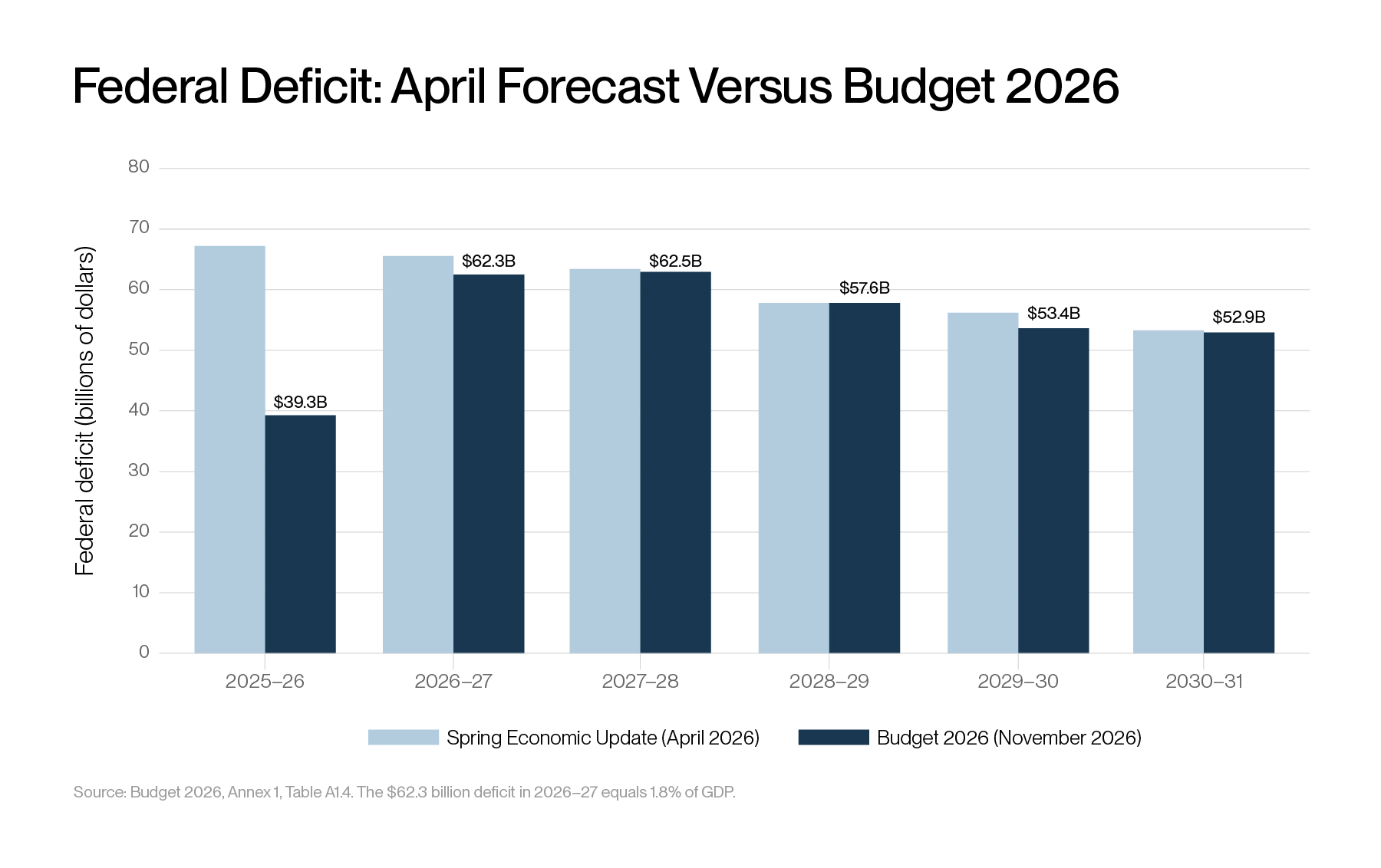
The deficit is expected to ease to $52.9 billion by 2030-31, with federal debt-to-GDP ratios projected to remain around 40% throughout that time. More concerning is the report on the amount of government revenues now allocated to paying interest on public debt: such payments are projected to grow to over $85 billion per year. This has important long-term implications on interest rates, the Canadian dollar, and federal spending programs.
On the interest rate front, forecasters surveyed expect two more rate increases within a year, and estimate inflation will be about 2.8% for 2026
Action Items:
- Anyone with a mortgage renewing in the next four months should consider asking for a rate hold now and test their budget at a rate at least 50bps higher than today's rate.
- If you’re a variable rate borrower, make sure to compare the cost of converting to a fixed rate mortgage now versus staying variable if interest rates rise further.
- Business owners should review any lines of credit and operating loans tied to the prime lending rate and consider paying down the most expensive balances first.
- If you're a bond investor, rising rate expectations will likely affect bond prices. Now is a good time to review how sensitive your portfolio is to rate changes. Be sure to talk with your Nicola advisor.
The Productivity Mega Deduction: Big News for Businesses
The business measure that grabbed headlines in September is now proposed as a permanent measure. The Productivity Mega Deduction allows businesses to write off the full cost of most equipment in the year that equipment is put to use instead of capitalizing it over several years. The change is a cornerstone of the government's attempt to kick-start business investment in productivity-enhancing equipment and to free up money within corporations so they can invest in other things.
Some examples illustrate how “mega” this deduction can be. Assume a sole proprietor dental practice purchases and deducts $120,000 of equipment during the year. At a 50% tax rate (just to keep the math simple), that practice could save a full $60,000 in tax that same year. Contrast this against the current $18,000 under the current rules and the remaining $42,000 or so of deductions gradually earned over a decade.


Another example: an incorporated BC business owner earns $600,000 in her qualifying business, $100,000 above the $500,000 Small Business Deduction limit (SBD). Under current rules, the $100,000 over the SBD would be taxed at the General Corporate Rate of 27%. However, if the business invested in $100,000 worth of equipment that year, the new Productivity Mega Deduction would bring total taxable income down to $500,000. That means first year savings of about $27,000 that would otherwise be paid in taxes can now be put to use elsewhere in her business.
A key goal of the Productivity Mega Deduction is to make Canada a more competitive destination for business investment. On this score, it looks like Canada will have a significant advantage. The tax on an additional dollar of business investment in Canada will fall to 6.4% from 13.0% previously. That’s considerably better than our neighbours to the south at 16.9%.


The new deduction is proposed to apply to any purchases made after September 14, 2026, but it won’t apply to every form of business investment. Investments in long-lived buildings, certain passenger vehicles, regulated gas pipelines, or intangibles do not qualify.
Action Items:
- Are you incorporated with equipment purchases planned over the next year or two? You’ll definitely want to talk to your accountant before you buy, not after.
- Under the proposed changes, your timing matters. The equipment must be in use by your corporation's year-end to claim the deduction that year.
- If your corporation earns more than the $500,000 small business limit, ask your accountant to model whether claiming equipment expenses will bring income down to the limit (see example above). Such a move could save you a considerable amount of tax.
- If you've already bought equipment after Sept. 14, ask your accountant about claiming the full write-off on this year's corporate return.
- Keep in mind that if a fully deducted asset is later sold, the sale price (up to what you paid) is generally added back to income. The tax is deferred, not forgiven.
The Canada Growth Incentive: the $15 Million Question for Founders
Another contender for most exciting item in this year's budget is the Canada Growth Incentive (CGI): a capital gains exemption of up to $15 million per person, per business. For business owners and entrepreneurs, this is an exceptionally attractive benefit; fully 12x the existing Lifetime Capital Gains Exemption (LCGE) of $1.25 million.
The budget provides an impressive example of this new incentive. Under the new rules, a founder with a $15 million gain would keep nearly 96% of it after tax. To express this in dollar terms: a founder in BC who incorporates now and sells in 2031 with a $15 million gain could realize a $4,012,500 tax savings (assuming BC's top capital gains rate of 26.75% and excluding Alternative Minimum Tax). That’s significantly more than the 71% under current rules, and more than in many other jurisdictions as well.


The government's stated purpose with the CGI is to boost Canada's technology, innovation, and manufacturing sectors. This emphasis becomes clear when reviewing the list of eligible businesses:


As you might expect from such a substantial tax benefit, there are several rules and regulations governing how owners and shareholders can claim the CGI. Under the proposed rules:
- You must be a Canadian resident aged 18 or older. Trusts don't qualify.
- Your shares must be newly issued by a Canadian-controlled private corporation on or after November 5, 2026 and before 2037. They must be issued for cash or for your own employment services. You must hold them in your own name.
- The company (together with related companies) must have under $100 million in assets when the shares are issued.
- The company must carry on an active business, primarily in Canada, in an eligible sector.
- You must own the shares for at least 36 months before you sell.
- Existing company shares don't qualify. Also, an established owner cannot reorganize a company to become eligible.
- You can't fully claim both the CGI and the LCGE on the same company; the details of that limit haven't been published yet.
- Alternative Minimum Tax (AMT) still applies, as it does with the LCGE.
Action Items:
- If you're starting a company, raising money, or granting shares to staff (in an eligible sector), think about structuring the share issuance with the Canada Growth Incentive rules in mind.
- If you have an existing company, keep in mind that existing shares do not qualify.
- Plan on investing in a new venture? Under the proposed rules, consider holding the new shares in your own name. The exemption applies to individuals; shares held through a holding company do not qualify.
- If you’re joining an eligible start-up, ask whether your equity will be issued as shares for your services (which qualify) or as stock options (which may not; the treatment isn't yet clear).
- Consider holding off on structures where several family members subscribe for shares until the government clarifies the rules against multiplying the exemption. We expect those to be published soon.
- Selling shares of an eligible small business and reinvesting the proceeds? A related change gives you three years to reinvest the proceeds and defer the tax, instead of having to do so at the end of the following year. The deferral can even extend to five years with a signed future equity agreement. However, the extra time only applies to sales dated on or after Jan. 1, 2027. If your closing date is soon, consider whether it may be beneficial to hold off until January.
IPP Surprises: Changes to IPPs Require Careful Consideration
Buried deep within the tax annex of the budget are several changes to Individual Pension Plans (IPPs). For many investors, this could be the most consequential measure in the entire budget.
To recap, an IPP is a defined benefit pension sponsored by a company for its owner (usually one and the same such as in the case of an incorporated physician). They can be an excellent way for incorporated professionals to shelter more retirement savings than an RRSP allows.
The budget proposes substantial changes to the regulations governing IPPs; any IPP holder will want to review them carefully and schedule an appointment with financial professionals (including their actuary) to ensure they stay on the right side of the rules.
The changes cover three important areas under the proposed rules:
1. Overfunded plans
The government wants to discourage IPPs that grow tax-free beyond what is needed to pay benefits. Starting January 1, 2028, an IPP worth more than 200% of its pension liability becomes a "revocable plan." Once CRA gives 30 days' notice, the excess must be withdrawn. If it isn’t, the plan will pay a special tax of 10% on its total assets (not just the overfunded portion), and 50% of what remains must go to CRA as a refundable deposit.
Here's an example. A doctor's IPP is worth $2,000,000 but its pension liability is only $900,000. To get back to 200%, the doctor can withdraw at least $200,000 as taxable income. Alternatively, the actuary can increase the plan's liability, for example by adding inflation indexing. If the doctor does nothing, CRA can revoke the plan’s registration and apply a $200,000 special tax. Then $900,000 will be held as a refundable deposit that earns no return until benefits are paid.
2. Qualified investments
Starting in 2028, IPPs can hold only approved investments, similar to the rules for RRSPs and TFSAs. A non-qualified or prohibited holding will face a 50% penalty on its fair market value. While the government has proposed transition rules to grandfather any prohibited investments currently inside an IPP as of January 1, 2028, it notes that future income from those investments will still face potential tax implications.


3. Closing the "add a relative" workaround
Under current rules, a defined benefit pension plan with four or more members isn't treated as an IPP. Some families added a spouse, children, or other relatives in an effort to circumvent this four-person limit, allowing the plan to avoid certain IPP rules and restrictions such as minimum annual withdrawals.
Starting January 1, 2027, a plan will be treated as an IPP if all its members are related to the company or connected to the owner, no matter how many members it has. Family "group" plans set up this way should be reviewed before the end of 2026.
Action Items:
- IPP holders should book an actuarial funded-ratio review early in 2027. Our advice: do it early. We expect there will be many IPP holders who will need to review their plans, and you don’t want to be caught in a last-minute rush.
- If your plan is currently overfunded, you may have to resume benefit accruals, index benefits, or make taxable withdrawals.
- Review your IPP holdings for prohibited holdings.
- If you anticipate needing to withdraw funds from your IPP to avoid the new overfunding rules, consider whether you can spread your withdrawals over multiple tax years to reduce tax. In our doctor example above, the $200,000 withdrawal done over two years could save approximately $17,000 in tax.
RRSPs For Life: Eventually. Maybe.
One budget item receiving a lot of attention is the proposed change to Registered Retirement Savings Plans (RRSPs). This is somewhat ironic as it is the one item that's still very much up in the air.
The government proposes to merge RRSPs and Registered Retirement Income Funds (RRIFs) into a single registered account. No longer would RRSP holders need to convert to a RRIF at age 71. Rather, they would hold an "RRSP for life." As of right now, this seems a change in nomenclature only: the minimum withdrawal rates that currently apply to RRIFs would still apply to the new RRSP-for-life.
The budget also proposes changes for spouses and common-law partners, enabling direct tax-free transfers to survivors upon death of the original RRSP holder. This is already essentially a feature of RRIFs and would greatly simplify such transfers.
We view such changes as encouraging, though we believe other changes could be more meaningful. Examples of the changes we’d be more excited about include:
- Reducing minimum withdrawal rates
- Raising the maximum RRSP annual contribution limits
- Increasing the age limit (currently 71) before annual minimum withdrawals are required
Action Items:
- There’s nothing to do (yet) about these proposals. The budget’s proposed changes are part of a broader consultation around retirement funding rather than a final decision.
- If you're turning 71 this year, you’ll still need to convert your RRSP to a RRIF by Dec. 31
- If you have an opinion or point of view on the RRSP proposals, the government wants to hear from you. It will accept submissions to the Department of Finance until Jan. 8, 2027.
- Something to be aware of. Any changes to locked-in retirement accounts (i.e., from former workplace pensions) may take longer to enact than the above changes to RRSPs, since they also involve changes to provincial pension law.
New Deadlines: Taxes Made Easy (or at Least… Easier)
The budget proposes a significant "tax simplification package" that would change how we submit our annual filings and when. The package consists of four notable changes:
1. Changing the Tax Filing Deadline. Starting with the 2027 tax year (returns filed in 2028), the deadline to file and pay any balance owing will move to May 15 for all individuals. Currently, most individuals must file and pay by April 30. Self-employed individuals (and their spouses or partners) can file by June 15, but any balance owing is still due April 30.
2. Increasing the Installment Payment Threshold. Currently, CRA requires taxpayers who owe more than $3,000 of net tax to pay income tax installments in the following year. Starting in the 2028 tax year, this threshold will be raised to $7,500 and will be indexed to inflation in subsequent years.
3. Increasing the Foreign Property Reporting Threshold. The current threshold of $100,000 will be raised to $200,000 after 2026. In practical terms, the change will mean more than a third of all current filers will no longer have to report.
4. Extending the Objection Deadline. Disagree with your notice of assessment? You currently have 90 days to file an objection with CRA. Under the proposed changes, you’ll have a full year from the day CRA sends you your Notice of Assessment, or two years from the filing due date.
Action Items:
- Nothing changes for your 2026 return: it's still due April 30, 2027 (June 15 for the self-employed), with any balance still due April 30.
- Owe installments for 2026 and 2027? Keep paying them as billed. If you fall below the proposed $7,500 threshold in 2028, set money aside monthly so the full bill at filing isn't a surprise.
- If you own taxable foreign property such as US stocks: under the proposed changes, the higher $200,000 threshold starts in the 2027 tax year. If your foreign investments cost more than $100,000 at any point in 2026, you still file the T1135 for 2026
The Canada Strong Fund: Sovereign Wealth Fund Ready for Take Off
The budget provided some additional details on the Canada Strong Fund, the new sovereign wealth fund that was alluded to in the Spring Economic Update. While such a Fund would be new to Canada, it’s a concept that’s familiar in over 70 countries (Norway, Singapore, and the United Arab Emirates are among the largest), as well as several U.S. states including Alaska, Texas, North Dakota, and more.
The budget explains many of the details of the Fund. The federal government plans to seed the Fund with $25 billion over three years. The Fund will invest only in Canadian opportunities in “strategic sectors” of the economy (technology, critical minerals, energy, infrastructure, etc.) and will take on minority stakes on similar terms as private investors. It will operate at arm’s length from the government as an independent crown corporation.
Early next year, the government plans to launch Canada Strong Notes, a hybrid product linked to the Canada Strong Fund. The budget outlines that these will be principal-protected and offer an annual interest payment (coupon) along with a share of the Canada Strong Fund’s returns. They’ll be offered in a variety of terms: for example, 5-year, 7-year, and perhaps 10-year. Key terms (coupon, return participation, return caps, redemption pricing, registered-plan eligibility) are not yet known.
The government intends to release further details on the Notes “soon.” It will first need to pass legislation that establishes the fund as an independent crown corporation. Expect more details sometime after that.
Action Items:
- As the notes are currently unavailable for purchase, no action items need be taken. We'll be watching closely for more news in the months to come and will outline our thoughts when we receive more information.
- That said, we do note that investment in infrastructure and growth companies often takes years to show returns. As such, it’s conceivablethat the coupon will form the bulk of the return on the Notes for the first several years.
Real Estate: Positive Measures for Developers
The budget commits to increasing housing supply and sets an audacious goal of ending homelessness within ten years. As part of that commitment, developers received some modest support.
Currently, larger developers face limits on how much interest they can deduct. The government had already proposed an exception for money borrowed to build purpose-built rentals; the budget widens that exception. Under the proposed changes, it would also apply when one company in a group borrows the money and an affiliated company in the same group builds the building, which is how most projects are structured. The change would apply retroactively to 2023.
The budget also makes financing for smaller builds a little easier. Starting February 1, 2027, new three- and four-unit homes can be financed with insured mortgages for up to 90% of their value. Buyers of new homes priced up to $1.5 million will have access to insured mortgages with 30-year amortizations. These changes should make new rental and infill projects somewhat easier to finance.
The federal ban on foreign buyers of existing homes was set to expire in January 2027. The budget proposes extending to January 1, 2029, with an exemption for newly built homes. This could widen the pool of buyers for pre-sale and new condominium projects. Details (including how the government defines "newly built") are still to come.
As active investors in real estate, we'll be watching this area closely as more details are released.
Action Items:
- If you're considering a three- or four-unit infill project, consider the February 1, 2027 start date when arranging financing (if your timing allows). Insured financing for up to 90% of value starts at that time, and could reduce the equity you need to put in.
- If you’re buying a new home priced up to $1.5 million, compare a 30-year amortization against a 25-year one. The longer term lowers the monthly payment but increases the total interest you pay.
- If you own pre-sale contracts or new condo units, watch for the definition of "newly built" under the foreign buyer exemption. A wider pool of buyers could help resale or assignment demand, but don't count on it until the rules are published.
Conclusion: Destiny? Or Debt? Time Will Tell ...
Whether this budget leads us to becoming "Masters of our Destiny" remains to be seen, but there is no doubt that this has been a substantial budget, with a number of wide-ranging implications for business owners and investors alike. Going forward, we believe the true test of this budget will be whether businesses answer Mr. Carney’s call to invest more. Over the next 12 to 24 months, business investment data will tell us whether the incentives introduced in this budget are actually working.
On the fiscal front, we note that the government’s plans rest on two central assumptions: (a) that oil prices remain elevated over the short- to-medium-term and (b) government spending growth slows. If either of these assumptions deteriorates, and deficits widen, we believe that could lead to added pressure on interest rates and on future budgets. With increasing debt service payments taking up an ever-larger share of federal spending, “Masters of our Destiny” could end up turning into “Masters of Debt.”
At Nicola Wealth, our work on Budget 2026 has already begun. In the weeks to come, we'll be addressing some of the implications of the budget measures further and exploring select budget initiatives in greater detail. For those likely affected households, we are reviewing Individual Pension Plans, family trusts, and private company shares. Again, we must stress that much of the budget is proposed and not yet law. Details can, and may, change before legislation passes; one reason why we’d caution against acting on these proposals alone.
In the meantime, if you'd like to know more about how the budget affects your family, your business, or your retirement, contact your Nicola advisory team. We'd be happy to step you through the budget items most relevant to you, and discuss how they might affect your finances, your family, and your future.
Disclaimer
This material contains the current opinions of the author, and such opinions are subject to change without notice. This material is distributed for informational purposes only and is not intended to provide legal, accounting, tax or specific investment advice. Forecasts, estimates, and certain information contained herein are based upon proprietary research and should not be considered as investment advice or a recommendation of any particular security, strategy, or investment product. Tax outcomes depend on your specific facts and may change as legislation is finalized.


