
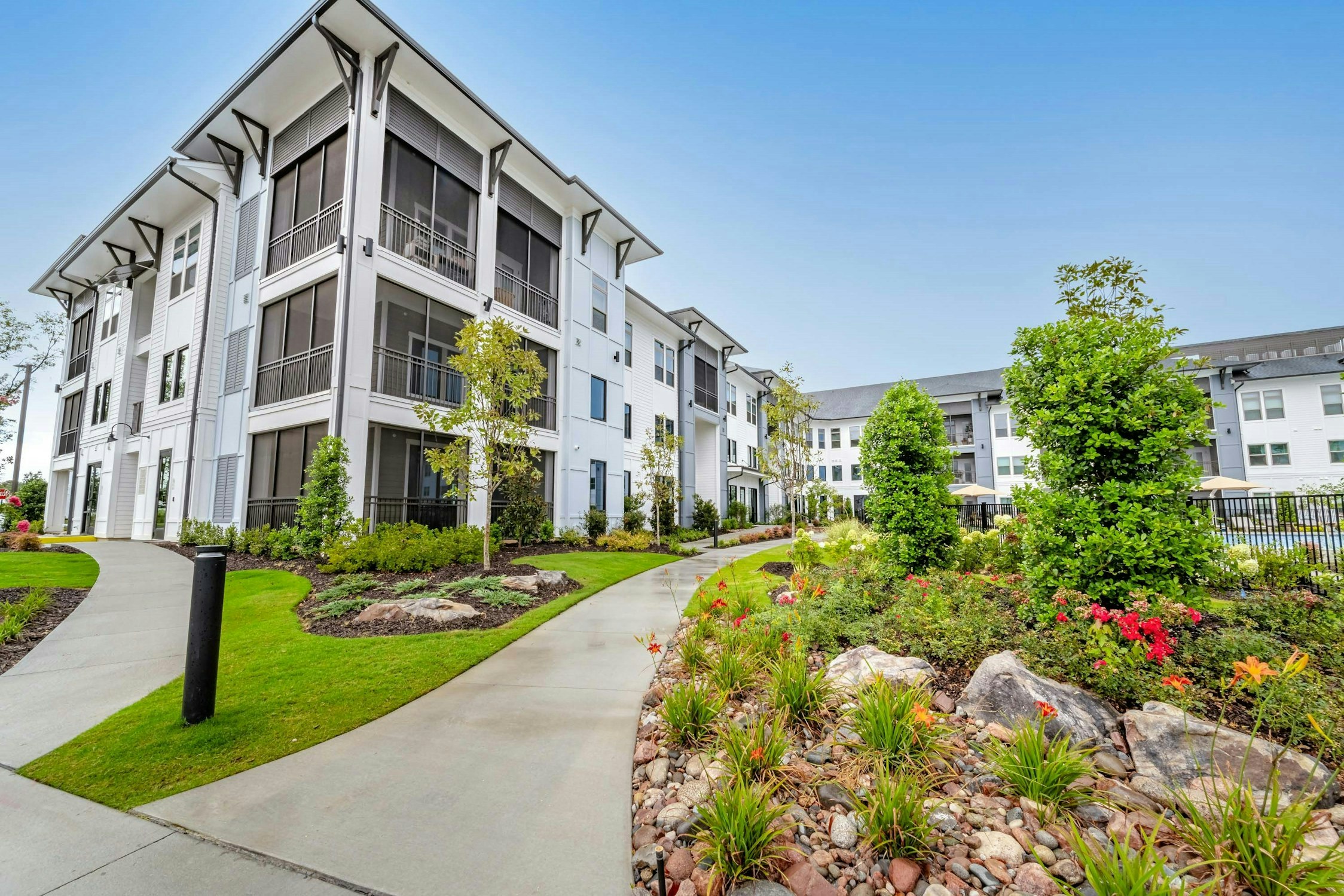
Despite market fluctuations, U.S. multi-family real estate has demonstrated resilience as an asset class, with a history of delivering relatively stable long-term returns. While recent short-term challenges have created uncertainty, we believe the fundamentals supporting this sector are favourable.
For over 18 years, investing in the U.S. multi-family rental apartment sector in partnership with Venterra Living (Venterra) has been a cornerstone strategy for the Nicola Real Estate team. As of December 31, 2024, this asset class represents approximately 55% of the gross value of the Nicola U.S. Real Estate Limited Partnership (NUSRE LP) portfolio. Since our first investment with Venterra in 2007, the portfolio has expanded to 93 properties and approximately 26,000 apartment units.
Since the inception of NUSRE LP in 2010, this asset class has historically performed well and has been a major contributor to the overall returns. However, over the past two years, the sector has been impacted by higher interest rates, leading to increased capitalization (cap) rates and downward pressure on property values. Additionally, a surge in construction of rental apartment units in the U.S. has led to an oversupply, putting downward pressure on rents. This combination of higher cap rates and lower rents has led to an adjustment to multi-family real estate values that has not been experienced for some time. So, what does this mean for the future of this asset class and investment strategy?
Why Invest in U.S. Multi-Family in the First Place?
Let’s start by providing an overview of why we like the U.S. multi-family asset class to help contextualize the current landscape. Our U.S. multi-family investment strategy targets geographic markets that operate freely with minimal government regulation. These markets are primarily located in “right to work” states across the South and Southeast U.S., regions that are pro-business and feature healthy employment growth and strong economic drivers. The investment thesis follows that where there is strong employment, wage, and population growth, there will be a greater opportunity for rental rates to increase. As income growth accelerates, property values typically follow suit.
With the operating prowess of Venterra, additional value creation will be realized through value enhancement strategies such as common areas and in-suite upgrades, as well as the implementation of their hands-on approach to management.
Strategic Investment Approach for this Asset Class
Nicola Real Estate team and Venterra’s investment strategy for the multi-family asset class is built on a foundation of careful market analysis and hands-on management. Our partnership centers on acquiring assets in high-demand regions that feature strong economic drivers. We focus on four key fundamentals that guide our approach:
- Diversification: Investing in a balanced variety of markets to spread the risk and capture growth opportunities.
- Debt Management: Adopting a conservative approach to debt management by limiting our exposure to a maximum loan-to-value of 65%, using mostly fixed rate loans and balanced maturities.
- Value Add Opportunities: Identifying properties where we can enhance value through renovations, effective management, and strategic positioning.
- Long Term Perspective: Prioritizing investments that achieve sustainable income growth and reliable returns over the long term.
The Oversupply of New Product
Following the onset of the COVID-19 pandemic, interest rates fell to record lows, sparking increased demand for rental apartment units, fueled in part by government stimulus payments. With lower interest rates, developers took advantage of record-low borrowing costs in 2021 and 2022. With free-flowing capital and an environment where rents were growing steadily, developers mobilized to capitalize on this opportunity. Given the timeline required to construct these projects, there was a lag in delivering the finished product. The resulting increase in the supply of rental apartment units reached a 50-year high in 2024, in terms of units completed, with 589,000 new units entering the market (Figure 1).


Figure 1
The substantial new supply delivered in 2024 significantly impacted rents for the multi-family industry, essentially bottoming out at or close to 0% for the second consecutive year against a backdrop of higher inflation. Year-over-year rent growth has essentially been flat since July 2023, meaning rents haven’t materially increased since July 2022 (Figure 2).


Figure 2
We are now passing 30 months of flat rents, and importantly, more than two consecutive years of rents growing at a slower pace than wage growth. This is significant as the sheer amount of new supply, and resulting stagnation of rent growth, has caused apartment rents to become increasingly affordable relative to incomes with each passing month.
Anticipating a Sharp Decline in New Supply
Despite reaching record highs, we are confident that we have passed the “peak supply” point in this cycle, and new deliveries will experience a sharp decline. Expected supply by quarter is shown in the chart below, with actuals through Q4 2024 in dark blue and forecast numbers in light blue (Figure 3). New supply has already started to decrease, and we anticipate a steeper decline by Q1 2026. At that time, new supply will fall below the average levels seen from 2015 through 2019, which translated to approximately 300,000 new apartment units per year.


Figure 3
The decline in construction starts is widespread across the country, with 2024 marking the lowest numbers on record in several markets. Prior to that, the last time the markets below experienced a decline in construction starts was:
- 2017 for Atlanta and Tampa
- 2015 for Jacksonville and Orlando
- 2014 for Dallas and Raleigh
- 2013 for Austin
- 2010 for Houston
On a national scale, construction starts haven’t been this low since 2013. The last time construction starts were this low, national rent growth in 2014 (5.1%) and 2015 (4.6%) was relatively strong. The primary reason rent growth has flattened over the past 24 months (with some markets experiencing negative growth) is the surge of new supply completing in 2023 and 2024. However, this surplus of inventory is forecasted to turn into a shortage by mid-2026.
The economics of developing new apartment units in the current environment are increasingly challenging, which will further strain new supply. Interest rates remain elevated, construction costs continue to rise, and there is an added layer of uncertainty around potential tariffs and their impact on construction materials. All these factors are compounded by the fact that the value of actual apartment buildings has declined due to higher cap rates and downward pressure on rents.
Demand Remains Strong for Apartment Units
Despite the surge in supply, demand for apartment units remains robust. In fact, 2024 marked the second-best year on record for apartment absorption—defined as the change in the number of occupied units over a period of time—with demand reaching 667,000 units, nearly matching the demand seen in 2021 (Figure 4).


Figure 4
We expect demand for apartment units to remain relatively strong. Given that wage growth has exceeded rent growth for more than two years, rents are becoming relatively more affordable compared to incomes. This improving affordability for apartments helps stimulate demand, enabling young adults to move out on their own or roommates to go their separate ways to form individual renter households. Meanwhile, home ownership continues to face persistent headwinds, as home values remain high, despite higher interest rates, which increase the cost of borrowing and thus the cost of ownership.
The bottom line is that based on the dwindling pipeline of new supply of rental apartment units, once the current oversupply is absorbed, rents are expected to be well-positioned to grow.
Property Values are Well Positioned for Growth
Although transaction activity significantly reduced through most of 2023 and 2024, there is a general sense that capital is slowly coming back into the space, with optimism that the market will start to improve. There are also signs that we are past the bottom of the market, as shown in the chart below (Figure 5). While cap rates increased for nearly two years off a low point in July 2022, in recent months, the average cap rate has started to decline, from a peak of 5.67% in May 2024 to 5.39% in December 2024 (the latest data available). The impact of the nearly 50-basis-point decline in the 10-year Treasury rate since the recent high point in December 2024 will not show up for a few months, as cap rates are a lagging indicator.


Figure 5
Why We Remain “All-In” on the Multi-Family Rental Apartment Asset Class
While it is difficult to make predictions on future outcomes, we remain optimistic about the long-term outlook for U.S multi-family rental apartment assets. In our view, as the current oversupply of units is absorbed and new development slows, rental rates should experience a strong recovery.
Additionally, a potential “reverse double-whammy” effect could further propel values if cap rates continue to decrease. Regardless of short-term fluctuations, our long-term approach to investing is designed to withstand multiple market cycles. As of December 31, 2024, occupancy levels for multi-family rental apartment assets within NUSRE LP remain above 90%, supported by managing debt leverage and ensuring healthy cash flow.
In conclusion, while the U.S. multi-family rental apartment sector faces some near-term challenges, we see this as a temporary phase rather than a fundamental shift. Our portfolio and partnership with Venterra are well-positioned to navigate the current economic landscape, seeing opportunity rather than risk. With a focus on diversification, debt management, value add strategies, supported by our long-term perspective, we remain confident that the sector is positioned for a rebound and, in our view, will continue to be a key driver of returns for NUSRE LP.
Disclaimer
Nicola Real Estate is the in-house real estate team at Nicola Wealth Management Ltd. This material contains the current opinions of the author, and such opinions are subject to change without notice. This material is distributed for informational purposes only and is not intended to provide legal, accounting, tax or specific investment advice. Forecasts, estimates, and certain information contained herein are based upon proprietary research and should not be considered as investment advice or a recommendation of any particular security, strategy, or investment product. Past performance is not indicative of future results. All investments contain risk and may gain or lose value. This is not a sales solicitation. This investment is intended for tax residents of Canada who are accredited investors. Residency restrictions apply. Please read the relevant documentation for additional details and important disclosure information, including terms of redemption and limited liquidity. Please speak to your Nicola Wealth advisor for advice based on your unique circumstances. Nicola Wealth Management Ltd. (Nicola Wealth) is registered as a Portfolio Manager, Exempt Market Dealer, and Investment Fund Manager with the required securities commissions.


