

Key Insights
- Market volatility rises amid tariff uncertainty
- Tariffs threaten U.S. economic growth
- U.S. exceptionalism meets challenges
- Tariffs complicate the global economic landscape
- Investors brace for potential stagflation scenario
Market volatility rises amid tariff uncertainty
The S&P 500 Index neared a technical correction in March, declining 9.8% from its February high before closing the month 5.6% lower. While not quite crossing the official 10% threshold, the volatility incited concern among investors.

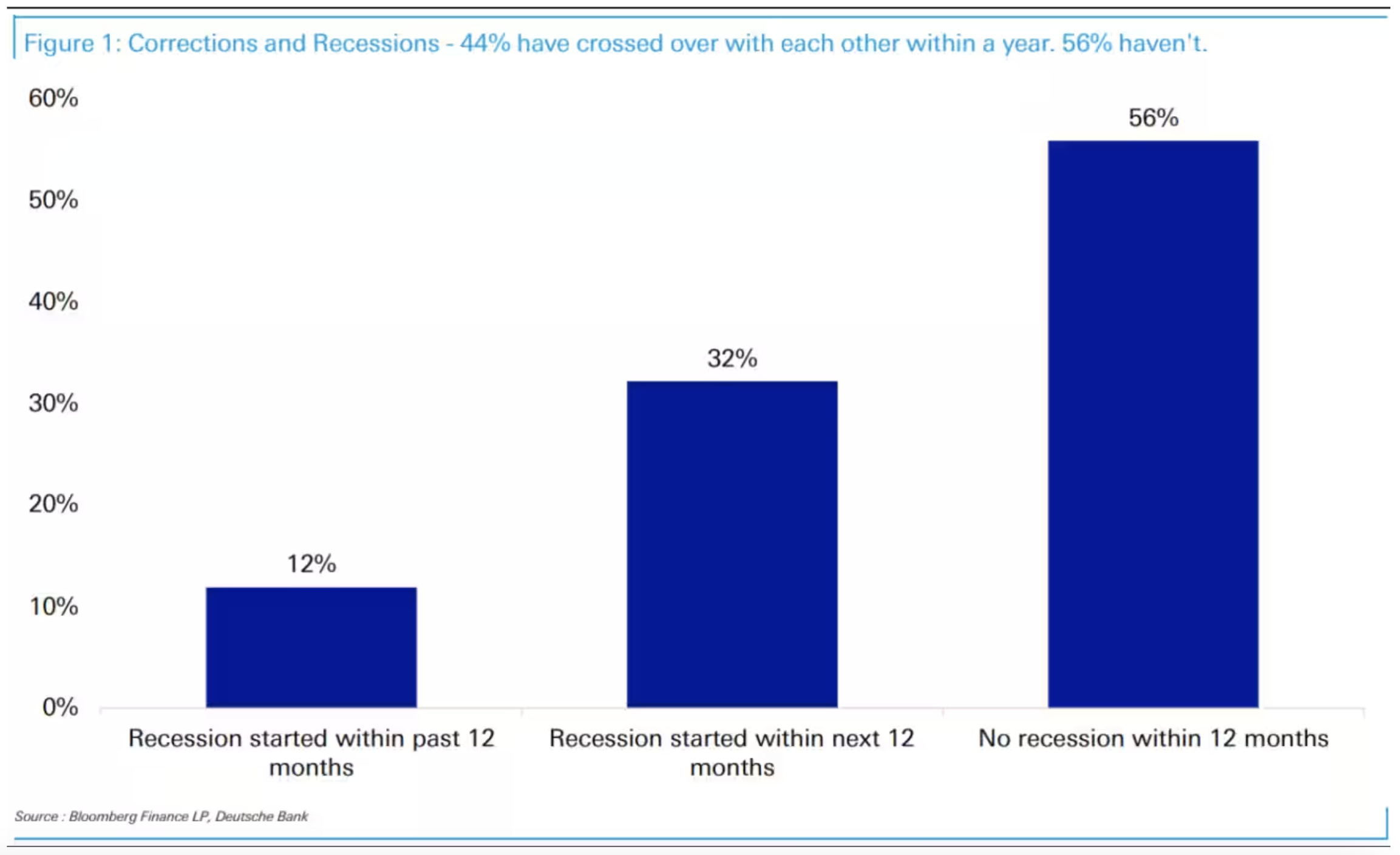
Significant market corrections may signal a looming recession, particularly when driven by increasing policy uncertainty. Research from Deutsche Bank shows that nearly half (44%) of similar corrections historically align with recessionary environments within 12 months.
Bloomberg labelled the current moment as a crossroad. Markets could begin to rally if recession fears are overblown, or they could continue their path downward, potentially reflecting a more severe downturn.
Tariffs threaten U.S. economic growth
Trump’s sweeping tariff policy disrupted markets and increased economic uncertainty. The policy set unprecedented tariff rates averaging about 22%. Surveys conducted by Bloomberg and Apollo indicated tariffs could trim U.S. GDP growth by about 1.5% while also pushing inflation higher.


The consensus among economists for substantial downward adjustments to GDP forecasts, paired with upward revisions to inflation projections, elevates recession risks for the upcoming year.
Even after President Trump rolled back some tariffs to a baseline rate of 10%, the disruption had already prompted markets to expect a higher probability of stagflation.
U.S. exceptionalism meets challenges
Betting on the economic strength of the U.S. has historically rewarded many investors in the past. Recent events, however, now challenge this longstanding view. March’s market results, with international equities outperforming U.S. stocks, raised some questions about the U.S.’s future economic dominance.


Foreign investors, who currently hold approximately 20% of U.S. equities and around 30% each of U.S. Treasuries and corporate debt, could reverse their capital flows if confidence in U.S. market stability deteriorates. A reversal like this could disrupt the U.S. financial landscape. It could also signal an inflection point that threatens the U.S.’s traditional economic supremacy.
Tariffs complicate the global economic landscape
President Trump’s tariffs unsettled allies and adversaries alike. The U.S. first imposed large tariff hikes broadly. Japan, a critical ally in Asia, faced a 24% tariff. Vietnam was hit with a staggering 46% tariff. Even Nauru, a tiny island in Micronesia with a population of under 12,000, was levied a 30% tariff.


Economists questioned the rationale behind these measures, and some criticized the tariffs as regressive.
The ramifications extend beyond immediate trade relations. Even international alliances and global economic dynamics may change. Analysts highlighted the difficulty businesses now face when planning and executing capital investments in a chaotic trade policy environment.
Investors brace for potential stagflation scenario
The dual pressures of rising inflation and declining growth prospects renewed concerns of a stagflationary environment, a challenging environment for markets and investors.


Stagflation constrains return potential across many traditional asset classes. While real assets such as commodities and real estate may benefit, stocks and bonds historically don’t. Research from Rosenberg and Bank of America showed that during stagflationary periods, investors typically pivot to defensive strategies. These include holding higher cash balances and more quality-driven investment approaches.
As the tariff turbulence continues, investors can focus on the fundamentals: robust diversification, defensive positioning if appropriate, and choosing high-quality assets to navigate economic and policy uncertainties.
Disclaimer
This material contains the current opinions of the author and such opinions are subject to change without notice. This material is distributed for informational purposes only. Forecasts, estimates, and certain information contained herein are based upon proprietary research and should not be considered as investment advice or a recommendation of any particular security, strategy or investment product. Information presented here has been obtained from sources believed to be reliable, but not guaranteed. Nicola Wealth Management Ltd. (Nicola Wealth) is registered as a Portfolio Manager, Exempt Market Dealer, and Investment Fund Manager with the required securities commissions. All values sourced through Bloomberg, unless otherwise specified.

